


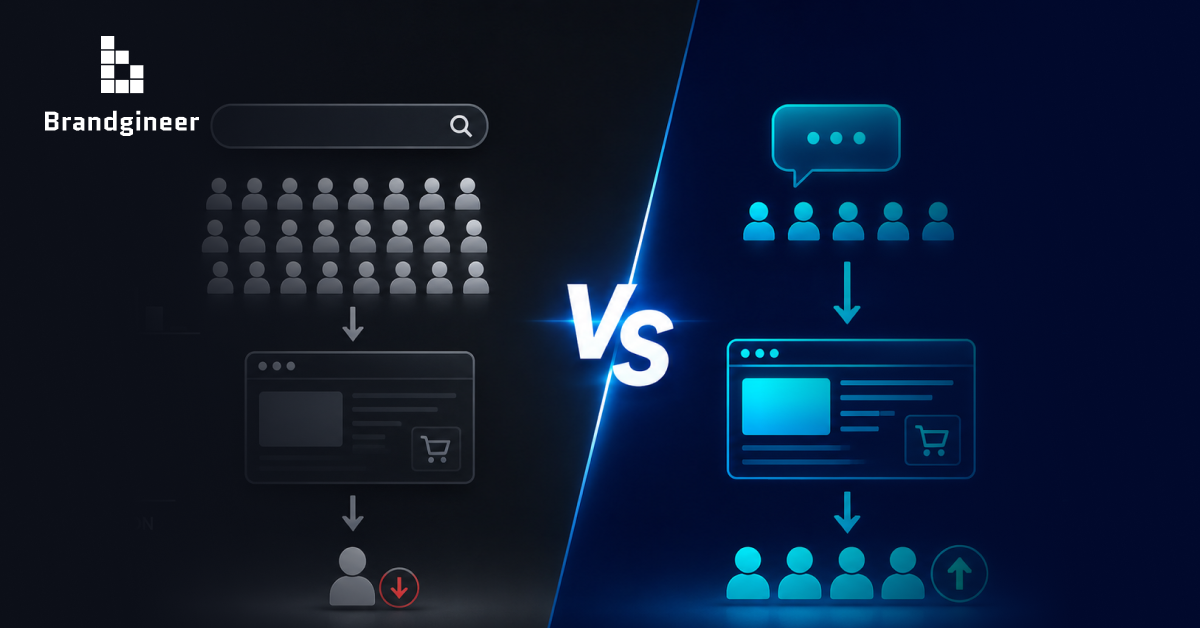
Visitors from ChatGPT, Perplexity, and AI Overviews are a small slice of traffic that converts far above its weight. Here is the data on how much better AI traffic converts, why it happens, the honest caveats, and why it is worth optimizing for now.
The short answer
AI traffic is small, but it punches above its weight. Visitors who arrive from ChatGPT, Perplexity, or Google’s AI Overviews tend to convert at much higher rates than traditional organic search visitors, because the model has already done the legwork: read the category, weighed the options, and handed the buyer a shortlist. Semrush found the average AI search visit is 4.4 times as valuable as a visit from traditional organic search, measured by conversion. [1] Adobe put it at 42% better for AI-referred visitors in retail in early 2026, a full flip from a year earlier, when they converted worse. [2]
The catch is volume. AI referrals are still a low single-digit share of total traffic for most sites. So the honest read is not that AI traffic replaces organic. It is that AI traffic is a small, high-intent channel, growing fast, and cheap to win right now.
This post covers how much better AI traffic actually converts, why it happens, where the claim breaks down, and why it is still worth your attention today.
What is AI traffic?
AI traffic, or AI referral traffic, is the visits that land on your site after someone clicks a link inside an AI answer. The sources are AI assistants like ChatGPT and Perplexity, plus AI Overviews inside Google.
It differs from a normal organic click in one way that matters. A traditional search visitor clicks a blue link and starts reading to form an opinion. An AI visitor has already read a synthesized answer, seen you stacked against the alternatives, and clicked through to act on a recommendation. Same person, later in the journey.
How much better does AI traffic convert?
Across independent studies, AI referral traffic converts at a higher rate than traditional organic search, and in a few segments the gap is wide. How wide depends on the industry and, honestly, on the month.
| Source | Segment | What it found |
|---|---|---|
| Semrush (500+ topics) | Cross-industry | The average AI search visit is 4.4x as valuable as a traditional organic visit, measured by conversion |
| Adobe Digital Insights, Q1 2026 | Retail | AI-referred visitors converted 42% better than non-AI traffic, reversing a 38% deficit a year earlier |
| Ahrefs analysis | B2B SaaS | AI drove 12.1% of signups from just 0.5% of sessions |
| Shopify, May 2026 | E-commerce product pages | AI-referred sessions converted about 50% higher than organic search |
| Adobe Digital Insights | Travel | AI still converted 28% lower than non-AI, though the gap is narrowing |
The numbers are not identical, but the direction is. AI visitors convert better in most categories anyone has measured, and the strongest lifts show up in B2B software and retail. The travel row is there on purpose. It is the clearest exception, and a useful reminder that the effect is not universal.
Why does AI traffic convert better?
AI visitors convert better because they show up pre-qualified. The model already ran the top of the funnel for them.
Ask an AI assistant which tool to use and it summarizes the category, weighs the options, filters out the poor fits, and hands back a short list of credible choices. Whoever clicks through has, in effect, already been sold. They arrive later, with fewer open questions and fewer competing tabs. A traditional search click usually lands at the start of research. An AI click usually lands near the decision.
That is also why earning AI traffic is not the same job as classic SEO. You are not trying to rank a page so a stranger can begin researching. You are trying to be the option the model recommends. How you do that is the subject of the companion piece, what gets cited in AI answers.
Where does the AI traffic advantage break down?
The conversion numbers are real. Treating them as the whole story would be a mistake. Four caveats keep this honest.
- Volume is small. AI referrals are still around 1% of total referral traffic for most sites, even after growing more than 390% year over year in US retail. A great conversion rate on a tiny base is still a small number of conversions.
- It swings by industry. The lift is strong in B2B SaaS and retail, but travel visitors from AI still converted 28% lower than non-AI traffic. Your category matters more than the headline average. [2]
- The benchmarks move fast. Adobe’s retail figure went from 38% worse to 42% better in twelve months. This is an early channel, and early numbers are jumpy, so hold any single one loosely. [2]
- Attribution is messy. AI referrals get undercounted all the time, because plenty of people read the answer, then retype your brand into Google or the address bar. Both the traffic and the conversion figures are noisier than a dashboard lets on.
None of that cancels the finding. It just reframes it. AI traffic is a high-quality channel that is still small and still settling, not a finished replacement for organic search.
Why should you optimize for AI search now?
The case for moving early is not that AI traffic is big. It is that it is high-quality, growing quickly, and cheap to win before the category fills up.
- The visitors are your best-fit buyers, already filtered and pre-sold by the model.
- The channel is early, and most competitors are still ignoring it, so becoming the recommended option costs less now than it will later.
- Being the answer compounds. When an AI presents you as the credible choice, that trust carries into other channels, including the branded searches AI referrals quietly create.
Put the growth rate next to the conversion rate and it is hard to shrug off. A channel that converts several times better than organic and is growing triple digits deserves attention well before it becomes a big share of traffic, precisely because it is easier to win while it is still small.
How do you earn more AI traffic?
Two jobs, in order.
- Become the source AI recommends. Answer engines pull from content that is easy to extract, backed by evidence, and corroborated on the sites they trust. That is the citation work, and it is what puts you in the answer in the first place.
- Match the landing experience to the intent. An AI visitor shows up ready to move, so the page they hit should let them move, with a clear next step, proof, and no second research loop. High-intent traffic dumped on a slow, generic page is the easiest conversion to lose.
The first job decides whether AI traffic shows up at all. The second decides whether it converts once it does.
What should you measure?
Break AI referral traffic out on its own, then judge it on quality, not size.
- Conversion rate by source, so you can put AI referrals next to organic search directly instead of burying them in one channel.
- AI referral share and its growth rate over time, which tells you more than the absolute number this quarter.
- Assisted conversions and branded search lift, to catch the buyers who met you in an AI answer but converted through another door.
Expect undercounting, and correct for it rather than trusting the raw referral number. The point is to see whether this small channel is outperforming its size, which, for most sites that have checked, it is.
AI traffic is the future, and now is the cheapest time to opt in
Organic search brings volume. AI search brings intent. The short version:
- AI traffic converts far better than organic: 4.4x more valuable per visit, and 42% better in retail in early 2026. [1][2]
- Why: the visitor arrives pre-qualified, because the model already researched the category and shortlisted you.
- The catch: it is still about 1% of traffic, volatile month to month, and it varies by industry, since travel still lags. [2]
- Worth optimizing now because it is high-intent, growing triple digits, and cheap to win before the category fills up.
- To earn it: become the source AI recommends, then match the landing page to the high intent.
- Measure AI referrals on their own, by conversion and growth, and correct for undercounting.
Câu hỏi thường gặp
These pairs power the FAQPage schema (see post-2-schema.html). Include them on the visible page or keep them schema-only, as you prefer.
What is AI referral traffic?
AI referral traffic is the visits that land on your site after a user clicks a link inside an AI answer, from assistants like ChatGPT and Perplexity or from Google AI Overviews. It arrives later in the buying journey than a normal search click.
Does AI traffic convert better than organic search?
Usually, yes. Semrush found the average AI search visit is 4.4 times as valuable as an organic visit by conversion, and Adobe found AI visitors converted 42% better than non-AI traffic in retail in early 2026.
Why does AI traffic convert better?
Because the visitor arrives pre-qualified. The model has already summarized the category, compared options, and recommended you, so the person clicks through near the decision rather than at the start of research.
How much of my traffic comes from AI right now?
For most sites, AI referrals are still around 1% of total referral traffic, though the channel grew more than 390% year over year in US retail in early 2026.
Is AI traffic better than organic traffic overall?
It is higher intent but much lower volume, so it is not a replacement. AI traffic is a small, fast-growing, high-converting channel that works alongside organic search.
Which industries see the biggest AI conversion lift?
B2B SaaS and retail show the strongest lifts, while travel still lags, with AI visitors converting about 28% lower than non-AI traffic, though that gap is narrowing.
How do I get more AI traffic?
First become the source AI recommends by making content easy to extract, evidence-backed, and corroborated on trusted sites. Then match the landing page to the high intent so the visitor can act.
Sources
1. Semrush, “We Studied the Impact of AI Search on SEO Traffic” (AI visit 4.4x more valuable). https://www.semrush.com/blog/ai-search-seo-traffic-study/
2. Adobe Digital Insights, Q1 2026, as reported by Search Engine Land (retail, travel, and growth data). https://searchengineland.com/ai-referrals-engagement-travel-sites-adobe-480445
3. Digiday, “In Graphic Detail: The state of AI referral traffic” (volume and growth context). https://digiday.com/media/in-graphic-detail-the-state-of-ai-referral-traffic-in-2025/
4. Ahrefs analysis of B2B SaaS traffic (12.1% of signups from 0.5% of sessions), as reported. https://www.averi.ai/blog/ai-search-visitors-convert-23x-higher.-everyone-s-ignoring-it.
5. Shopify AI referral conversion data, May 2026, as reported. https://www.digitalapplied.com/blog/ai-traffic-converts-42-percent-better-2026-channel-strategy