


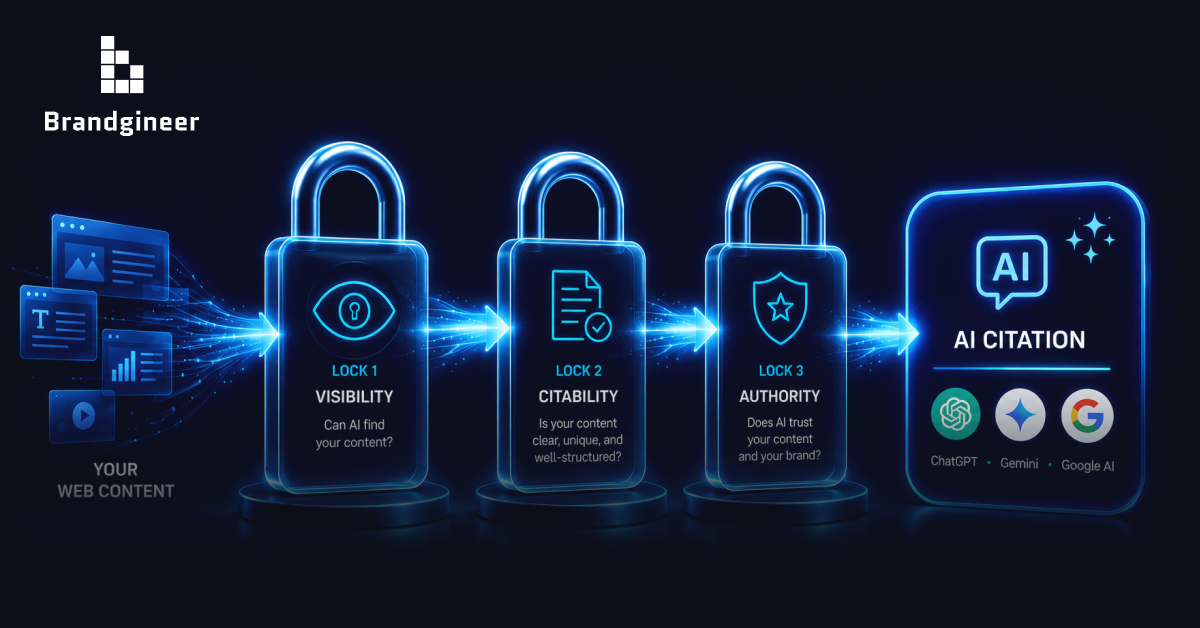
What actually gets a brand cited in AI answers: the three gates every page has to clear
Before an AI engine will cite your page, it has to pass three gates: discover, retrieve, and cite. This breaks down what each gate rewards, why ranking on Google no longer carries you through, and how to optimize for all three.
The short answer
A page has to clear three gates before an AI engine will cite it: discover, retrieve, and cite. It has to be discoverable, so the engine can find it in the first place. It has to be retrieved, which means getting pulled into the small set of sources the engine actually weighs for a given question. And then it has to be quotable enough to make the answer, with a link back to you.
Most pages do not fail at the first gate. They fail at retrieval or citation, and nobody notices, because everyone is still staring at rankings.
Ranking on Google will not carry you through anymore. Ahrefs looked at 863,000 SERPs and found that only 38% of the pages cited in Google’s AI Overviews also rank in the top 10 for that query, down from 76% a year earlier. Almost two-thirds of cited pages now sit outside the top 10. [1]
So ranking is not the job now. Passing all three gates is. Here they are, one at a time.
Is getting cited the same as ranking on Google?
Not really. Ranking rewards position on the page. Citation rewards being useful to one specific answer.
A regular search engine hands back ten links and lets you pick. An answer engine reads the sources, writes a single response, and footnotes the claims it used. Most of the time the reader never scrolls the list. So the thing you are competing on changes. It is not “can my page rank” anymore. It is “would a model actually quote my page when it answers this exact question.”
Ranking still helps, mostly at the first gate. It makes a page easier to find, and sometimes easier to pull. It does almost nothing for the citation itself. That is how a page can sit at number one and still be missing from the answer printed right above it.
Gate 1: Discover, can an AI find your page at all?
A page cannot be cited if it is not in the index the engine draws from. No crawl, no index, no pool, and the other two gates never get a turn.
This is the gate most sites already clear, which is exactly why it gets ignored. It is still worth a look, because a handful of small mistakes quietly pull pages out of the running:
- A noindex tag or a robots rule that keeps the page out of the index.
- Blocking AI crawlers like GPTBot, Google-Extended, or PerplexityBot, which cuts you out of those engines even when Google can still see you.
- Content that only renders with JavaScript, so the crawler sees an empty shell.
- Orphan pages with no internal links, which are slow to find and easy to drop.
Engines do not all discover content the same way. Google’s AI Overviews pull from Google’s index. ChatGPT and Perplexity lean on their own retrieval and, often, live browsing. If your page is not in the index an engine trusts, you are invisible to it before the real contest even starts. Clearing this gate is not an edge. It just keeps you in the room.
Gate 2: Retrieve, will the engine pull your page for this question?
Being in the index is not the same as being pulled. For each question the engine grabs a small set of candidates, and it leans toward relevance and toward sources it already trusts. This is where most pages quietly lose.
Part of it is how these engines read a question now. They do not match one query, they expand it. Google has confirmed its systems run a “query fan-out,” breaking a search into several related sub-queries and pulling the pages that keep showing up across them. Ahrefs’ data suggests AI Overviews now lean less on the direct results and more on those fan-out results, which is why so many cited pages never ranked for the original query. [1]
The rest is where engines choose to look. They do not pull evenly from the open web. They cluster around a short list of domains they treat as reliable, and those mostly are not brand blogs.
Semrush’s study of the most-cited domains in AI found citation concentrated in a small group of high-authority sites, with community and reference platforms near the top. [3] Search Engine Land, working from 30 million sources, put Reddit, YouTube, and LinkedIn as the three most-cited domains across AI answers. [4] 5W found Wikipedia and Reddit alone drive more than a quarter of ChatGPT citations in the US, while several big news outlets did not crack the top 20. [5] In Google’s AI Overviews specifically, Ahrefs names YouTube the single most-cited domain. [1]
Earned coverage beats owned content here too. A December 2025 study from Stacker and Scrunch found that pushing the same article out across third-party sites lifted its citation rate from around 8% to 34%, while brand-only content stayed near 8%. [6] Distribution, not the writing, decided whether the page got pulled.
So passing this gate is two things. Cover the fan-out of sub-questions a buyer’s query sets off, and show up on the sources the engine already reaches for. One page on your own domain is a thin bet.
Gate 3: Cite, will the engine actually quote you?
Once a page is pulled, it still has to be quotable. The engine cites the passages that answer the question most directly and credibly, and it skips whatever it cannot lift cleanly.
The clearest evidence here comes from the study that named the field. In “GEO: Generative Engine Optimization” (ACM SIGKDD 2024), Aggarwal and co-authors tested which content changes made a source more likely to appear in generative answers. The right ones lifted a page’s visibility by up to 40%. [2]
And they were not tricks. They were evidence: adding relevant statistics, adding quotations from credible sources, citing sources outright. The effect shifted by topic, with statistics doing the most on law, government, and opinion questions, and quotations doing the most on people, society, and explanatory ones. [2] The pattern is simple enough. Answer engines reward content that carries its own proof.
Cited passages tend to share a shape. The table below lines up what gets skipped against what gets quoted.
| Dimension | Skipped page | Cited page |
|---|---|---|
| Opening | Warms up with context before the answer | States a direct, self-contained answer in the first two sentences |
| Evidence | Makes broad claims with no source | Names statistics, dates, and attributed sources |
| Structure | One long narrative | Short sections, each answering one question |
| Extractability | Answer is spread across paragraphs | Answer sits in a list, table, or single clean passage |
| Language | Category-level and vague | Names specific roles, numbers, and outcomes |
| Distinctiveness | Repeats the consensus answer | Adds a number, benchmark, or angle others do not |
The common thread is extractability plus trust. The engine has to be able to lift a clean answer off your page, and it has to have a reason to believe it. Miss either one and you get pulled but not quoted, the frustrating “mentioned, not cited” limbo.
A teardown: watching the three gates in one query
You can watch all three gates in about ten minutes. Run one buying-stage question through an answer engine and open every source it cites. No tools required. Ask something your buyer would actually ask, read the answer, and look at what it quoted.
The same pattern shows up on B2B software questions like “best tools for X” or “how do teams solve Y.”
The answer rarely cites the vendors it names. It lists five products, then cites a roundup, a Reddit thread, a review site, and maybe one vendor page that happened to have a clean comparison table. The brands cleared retrieval enough to get named. Their own sites never cleared the cite gate.
When a vendor page does get cited, it looks a certain way. It answers the exact question in the first paragraph. It has a table or a short list the model can lift. It puts numbers in context. It reads like a reference, not a pitch.
The pages that never show up at all usually lost earlier. They were not part of the fan-out, or they lived only on a domain the engine does not reach for. Run this on ten questions in your category and you will see exactly which gate you are losing, and whether the fix is on your page or off your domain.
Why does AI cite third-party sites instead of your blog?
Your blog is where you control the message. It is just not where most citations come from.
This one surprises people. You can write the best page on the internet about your category and still watch an engine cite a Reddit thread and a roundup instead. The retrieve gate is why. Engines lean on earned, corroborated sources, and a vendor blog on its own is neither. [3][6]
So the blog has two jobs. It has to be quotable enough to win the cite gate on the occasions a model does reach for a vendor source. And it has to be the reference those more-retrieved sources point back to. When a roundup writer, a Reddit reply, or a comparison site needs a number or a definition, yours should be the easiest one to cite. That is how you land in the answer even when your domain is not the source.
How do you get cited in AI answers, gate by gate?
Start with one high-value question, the kind a buyer asks right before they build a shortlist. Then work the gates in order.
Clear the discover gate.
- Confirm the page is indexable, server-rendered, and internally linked, and that you are not blocking the AI crawlers you care about.
Clear the retrieve gate.
- Cover the fan-out. Map the sub-questions the main query sets off and answer them, so you show up across the related results, not just one. [1]
- Get corroborated off your domain. Earn a mention in a roundup, answer the question honestly in a relevant community, get listed on a comparison site, and use video where the engine favors it. [4][6]
- Test per platform, because ChatGPT, Perplexity, and AI Overviews pull from different sources. [3][5]
Clear the cite gate.
- Answer the question in the first two sentences, before any story. Assume the reader is a model deciding whether to quote you.
- Add evidence a model can lift: statistics with dates, quotations from named sources, a comparison table, a defined term. [2]
- Structure for extraction, with short sections and question-shaped headers, so any passage stands on its own.
- Say something the top-cited pages do not, then refresh it on a schedule as answers get re-synthesized.
The companion to this piece picks up the next question: what this shift does to your traffic, since being named in an answer without being clicked changes what your analytics show. That is the follow-up post, AI traffic vs organic traffic: why AI visitors convert better (internal link to be added once published).
What should you measure to improve AI citations?
Measure each gate, because one “are we cited” number hides where you are actually losing.
- Discover: is the page indexed, and are the AI crawlers you care about allowed in.
- Retrieve: how often your brand or domain shows up as a candidate or a mention for your priority questions, and which third-party sources sit alongside you.
- Cite: how often you are the quoted source versus a third party, and where you are “mentioned but not cited.”
Watch the trend, and check per platform, since engines reshuffle their sources constantly and a citation you hold this month can be gone next month. This is not about a tidy dashboard. It is about spotting which gate is leaking so you fix the right one.
Getting cited comes down to clearing all three gates
Getting cited is not a growth hack. It is what happens when a page clears all three gates at once, and enough of the web agrees that it should. The short version:
- Getting cited means clearing three gates in order: discover, retrieve, cite. Most pages fail at retrieve or cite, not discover.
- Ranking no longer carries you. Only 38% of the pages cited in Google’s AI Overviews still rank in the top 10. [1]
- Discover: stay indexed and crawlable, and do not block the AI crawlers you care about.
- Retrieve: cover the query fan-out and earn presence on the third-party sources engines trust. Earned beats owned. [1][3][6]
- Cite: answer first, then add evidence a model can lift. The GEO research put that lift at up to 40%. [2]
- Measure per gate and per platform, not with one “are we cited” number.
Câu hỏi thường gặp
These pairs power the FAQPage schema (see post-1-schema.html). Include them on the visible page or keep them schema-only, as you prefer.
What does it take to get cited in an AI answer?
A page has to pass three gates: discover (be indexed and crawlable), retrieve (be pulled into the engine’s candidate sources for a query), and cite (be quotable enough to appear in the answer). Most pages fail at retrieval or citation, not discovery.
Does ranking first on Google get you cited by AI?
Not reliably. Ahrefs found only 38% of pages cited in Google’s AI Overviews also rank in the top 10 for that query, down from 76% a year earlier.
What is the most effective way to improve AI citations?
Add evidence. The GEO study at SIGKDD 2024 found that adding statistics, quotations, and cited sources can improve a page’s visibility in AI answers by up to 40%.
Which websites do AI engines cite most?
Community and reference sites dominate. Reddit, YouTube, LinkedIn, and Wikipedia rank among the most-cited domains, and YouTube is the single most-cited domain in Google’s AI Overviews.
Why does AI cite third-party sites instead of my brand’s website?
Engines weight earned, corroborated sources over vendor-owned pages. One 2025 study found distributing an article across third-party sites raised its citation rate from around 8% to 34%.
Do different AI platforms cite the same sources?
No. Perplexity leans on community sources like Reddit, while ChatGPT favors reference and editorial domains, so visibility should be measured per platform.
What is query fan-out and why does it matter for citations?
Query fan-out is when an engine splits one question into several related sub-queries and pulls the pages that appear across them. Google has confirmed it uses this, which is why pages that never ranked for the original query still get cited.
Sources
1. Ahrefs, “Update: 38% of AI Overview Citations Pull From The Top 10” (863K SERPs analyzed). https://ahrefs.com/blog/ai-overview-citations-top-10/
2. Aggarwal, P. et al., “GEO: Generative Engine Optimization,” ACM SIGKDD 2024. https://arxiv.org/abs/2311.09735
3. Semrush, “The Most-Cited Domains in AI: A 3-Month Study.” https://www.semrush.com/blog/most-cited-domains-ai/
4. Search Engine Land, “AI search engines cite Reddit, YouTube, and LinkedIn most: Study.” https://searchengineland.com/ai-search-engines-cite-reddit-youtube-and-linkedin-most-study-473138
5. 5W Research via PR Newswire, “Wikipedia and Reddit Now Drive Over 25% of ChatGPT Citations in the U.S.” https://www.prnewswire.com/news-releases/wikipedia-and-reddit-now-drive-over-25-of-chatgpt-citations-in-the-us-new-5w-research-finds–wsj-nyt-and-bloomberg-do-not-appear-in-the-top-20-302768339.html
6. Stacker and Scrunch, “Earned distribution and AI citation rates,” December 2025, as reported by Machine Relations Research. https://machinerelations.ai/research/earned-vs-owned-ai-citation-rates-2026